Fast fashion vs slow fashion is like yin and yang in the arena of fashion world. Though the terms are completely opposite, there is a need of sensing their difference and concretely know which means what- fast fashion vs slow fashion-what are the differences, fast fashion and slow fashion brands, which fashion to choose when, etc.
What comes to your mind when someone says fast fashion vs. slow fashion?
On the surface, fast and slow fashion seem pretty straightforward, but in reality, they can both be complex within the realm of sustainable fashion. Today we will cater you a case study on fast fashion vs slow fashion where you will find the differences and a comparative study to ponder on.
[Attention! Read the full article. There is a fun quiz to check your knowledge about fast fashion vs slow fashion]
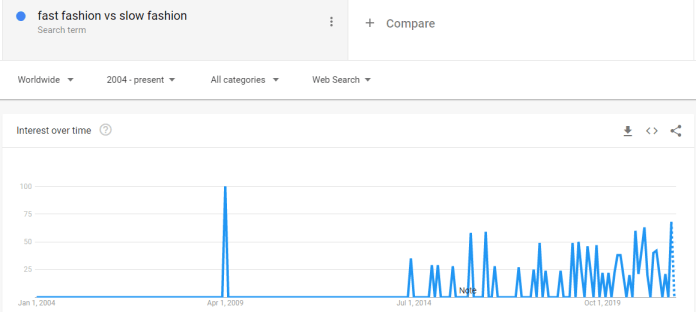
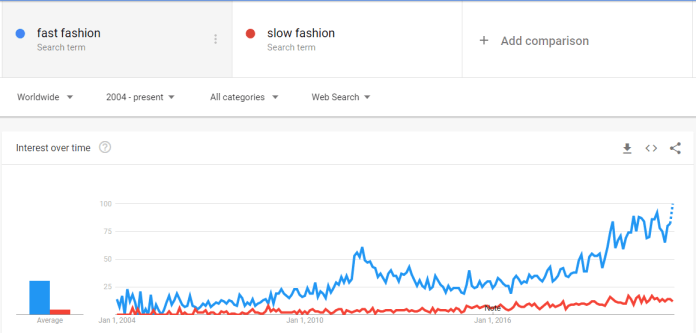
According to Google Trends, the highest interest in this topic was in April 2009 and the second highest interest is on October 2021.
What is fast fashion?
Fast Fashion is the process of imitating trends and styles from the big-name designers on the runway which is most of the time lower quality, cheap priced and not handmade. Manufacturers mass-produce the garments at lightning speed to beat the competition and keep up with customer expectations. Since the Clothing is produced quickly and cheaply, hence we term it as fast fashion.
Fast fashion examples:
H&M, Zara, etc. retailing brands’ mass produced t-shirts, pants, etc.
Fast fashion vs Slow fashion brands:
Fast fashion and slow fashion brands also have differences according to their design, production, selling and operating criteria which enable us to do Fast fashion vs slow fashion brands comparison.
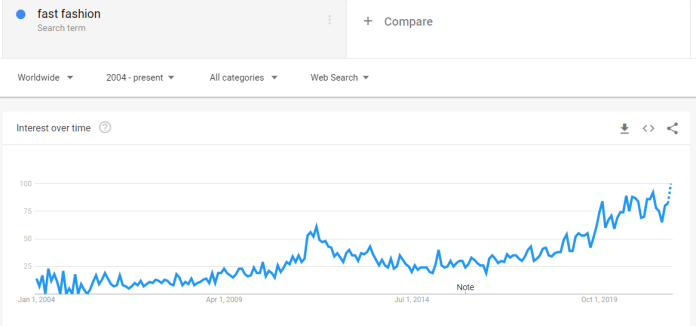
Interest in the ‘Fast fashion’ topic according to Google Trends. Source: Screenshot taken from Google Trends.
What is Slow Fashion?
Slow fashion is about conscious shopping and wearing clothing with sustainability in mind.It is about designing, creating, and buying clothing that last a long time. Here quality matters over quantity and since the process takes place slowly, we term it as slow fashion.
`
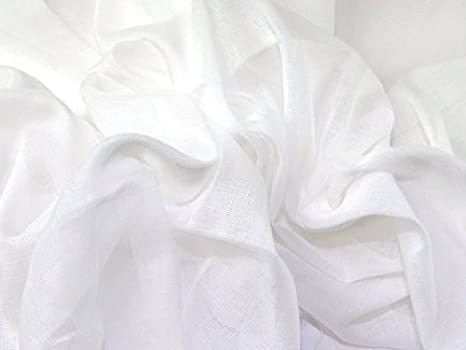
Dhakai Muslin, an example of slow fashion
Slow fashion examples:
Handmade classical products like Jamdani, Dhakai Muslin, Nakshi kantha, etc. Moreover vintage and second hand clothes are also a part of slow fashion.
Slow fashion history:
The term ‘slow fashion’ is not so old. In fact, this term emerged in the year 2007 when journalist Kate Fletcher, a fashion and sustainability pioneer, coined the word “slow fashion” in an article published in the British publication-The Ecologist.
`
The photo of Kate Fletcher who coined the term ‘slow fashion’. Her name is now attached with the history of slow fashion.
Actually, the concept of slow fashion is inspired from the Slow Food Movement founded by Carlo Petrini in Italy in 1986 which links pleasure and food with awareness and responsibility.
After her coining out this term, it became a world trend and talk of the fashion world.
Is slow fashion more sustainable than fast fashion?
Slow fashionpromotes a slower, steady and more sustainable approach as it is hand-made with sustainable raw materials like lotus, banana, orange fiber andpromotes the use of vintage or second hand clothes, upcycling old clothing materials. It decreases carbon footprint and takes care of the 3Ps of sustainability- People, planet and profit.
Comparing the benefits of slow fashion and fast fashion
Slow fashion reduces the consumption of resources and the amount of wasteland people can wear for a long time because they are made up of durable materials but is not cost efficient.
Fast fashion quickly responds to rapidly-changing fashion trends and consumer tastes.It carries high-end designs to the masses at affordable price ranges.
Fast fashion vs slow fashion Google Trends. The interest and talk of fast fashion was always more than slow fashion from the beginning. Source: Google Trends.
Let’s compare the problems faced
In Slow fashion small quantities are produced at low speed and hence are not able to compete with the economy of scale strategy. And generally, the products are more expensive than the commodities.
Due to the greater manufacturing speed, the factories are likely to neglect the working conditions. The low quality and low pricing of the products results in the increase of fashion waste
Comparing the production schedules
Slow fashion has 2-3 cycles per annum whereas fast fashion has approx. 50+ cycles per annum. We can clearly see the production scale of fast fashion is near 25 times of the slow fashion !!!
Comparing the fashion sales
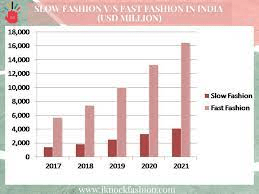
We can see the graph of slow fashion is very low at the beginning, but gradually the graph of slow fashion can be seen increasing, which means slowly people are understanding the importance of slow fashion. Though the graph of fast fashion is increasing rapidly because people always prefer cheaper prices over quality clothing.
Fast fashion vs slow fashion in India (USD Million).
Fast Fashion
Slow Fashion
Production
Rapid and mass production
Slow and deliberate production
Design Approach
Trend-driven and short-lived designs
Timeless and enduring designs
Manufacturing
Outsourcing to low-cost labor countries
Emphasis on local, ethical manufacturing
Material Selection
Synthetic materials and low-cost fabrics
Natural, organic, and sustainable materials
Environmental Impact
High pollution and waste generation
Focus on sustainability and eco-friendliness
Consumer Behavior
Impulse buying and frequent purchases
Conscious consumption and fewer purchases
Supply Chain
Lack of transparency and unethical practices
Ethical sourcing and transparent supply chain
Social Responsibility
Exploitation of low-wage workers
Fair wages and labor rights
Longevity
Disposable fashion with short lifespan
Durable garments designed for longevity
A table showing the differences between fast fashion and slow fashion.
Conclusion
After looking at the facts & surveys we can say that:
Fast fashion creates a lot of wastage and hence is quite harmful to the environment hence slow fashion should be promoted more in order to maintain sustainability
But when looking at the prices fast fashion is more preferable due to it’s cheaper prices.
But in the end, it depends on what the customer wants and what he prefers. It has to be either quality products/cheaper prices.
Nandini Kapu
Student at NIFT- National Institute of Fashion Technology
(NB. This article was written by Nandini Kapu. It has been updated and will be updated by Fashionnovation whenever we find new relevant information to make it rich so that the information best serves you. So, stay with Fashionnovation!)
You can also read another of our premium article on Fashion in the 21st century here!
Say, you are asking someone- why textiles are important? The most typical answer would be- textiles are important to decorate our homes, prettify our bodies and also for modesty. But the notion of textile in space has not yet surpassed the notion of clothing allowing us to make our own recognition and playing a principal role in cultural rituals and celebrations. The truth is, textiles are now far beyond these primary necessities and are now reigning in space, which gives rise to the concept of Textile in space!
Over the past few decades, technical textile fibers have achieved an undeniable and unavoidable position for textile in space and as a fundamental segment of end product structure. The development in the field of material science has placed an increased emphasis in finding innovative swaps to excel in performance of the existing composites. Lighter weight, comparable in strength with metals, higher strength to weight ratio, modifiable in size, flexible in handling and many more unique characteristics come up with interesting novel applications to textile materials. Therefore, it is not strange to realize the application of a stream of innovative fibrous composition in the space above and beneath the land.
And to talk about human beings reaching the stars, technical textile fibers are one of the core reasons that made this dream possible. In this regard, textile in aerospace is a significant incident now.
Do You Know the Reality Above the Land?
Before knowing the technical textiles associated with aerospace, it is important to know the definition of space and aerospace. As these terms have a strong kinship with textile engineers!
Space
A limitless surrounding that, according to modern science, a vacuum extent that is not exactly empty. It contains planets, stars, galaxies and many more particles and plasma matters. Normally, known as outer space, it starts above the earth’s atmosphere. There is no gravity in space, no air, no atmosphere. So, there is no way to resist a very high level of radioactive rays – which are blocked by the earth’s magnetic field- hence, all living things survive. Temperatures there are either hot (such as in case of an explosion of a star) or very cold (nearly -455o F, it’s that cold!). Nonetheless, the human body does not yet have the ability to cope with such extreme environments.
There are so many radioactive rays in space that it is still mysterious exactly what harm they can do to the human body. For this reason, people in space have to wear special clothes which are called space suits. Manufacturing of such garment requires special methods and processes, particular environment is created by controlling the temperature and air pressure – so that people can live in it. And in this regard technical textiles have mind blowing contribution.
The Milky Way Galaxy- shining bright- bearing thousands of wonders! Courtesy: Pexels
Aerospace
Aerospace is the branch of technology affiliated with both aviation and space flight. In this era of modern technology, this term is now a common expression. Although, as previously mentioned, the outer space relates to the vacuum environment that goes beyond the earth’s atmospheric levels, aerospace does not only belong to outer space. It also coincides with earth’s atmosphere. The section of technical textiles is rendering great service in this field. By fulfilling all the requirements to ensure the safety of the aerospace connected issues, they become an inseparable part of aerospace. And this amalgamation of textile technology and aeronautical technology has created a new field known as Aerospace Textile!
What Textiles Are Used in Space?
Getting to Know the Features of Textile in Space: Aerospace Textile
Aerospace textiles are obviously something that requires technical or high-performance fibers; these fibers posses certain characteristics that differ from the commodity fibers. These characteristics help enormously for the functions of astronauts, pilots and other professionals. Based on 3D reinforcement, a narrow range of aerospace composites are used for this field. Spontaneously, the curious mind would want to know about the exceptional features to develop aerospace textiles! Here are some key features-
Good fatigue and stress resistant
Abrasion and tear resistant
High specific modulus and strength
Heat insulation and heat resistant
Fire retardant
Good dimensional stability and comfortability
Resistant to harmful radiation
Lightweight and flexibility
Resistant to chemical and organic solvents
Moisture resistant
Good electrical insulation
Adequate washability and durability
The inside of a spacecraft- application of textile materials all around. Courtesy: Unsplash
Materials used to produce the aero-products!
High performance fibers & nano technical fibers with a combination of smart technology are widely used in the production of technical textiles such as: Polyester, Nylon, Dacron, Kevlar, Carbon, Glass, Aramid, Nomex, Spandex, Spectra, Silk etc. There are obviously much more than these. Let’s get to know some of these amazing hairlike materials, shall we?
Carbon Fiber:
It is the material consisting of very thin fibers. The diameter ranges from about 0.0002” to 0.0004” and contains mostly carbon atoms as it is produced from the pitch, which is produced as the by-product during the cracking procedure of crude oil. It is similar to graphite in construction as it contains hexagonal graphene layers. The carbon percentage in the composition is almost equal to 100%. Carbon fiber is familiar for its high specific strength in the aerospace industry. Some basic properties are-high tensile strength, lightweight, heat resistant and not attacked by chemicals.
Aramid/Kevlar:
Originally introduced by Du Pont in 1973, the Aramid fibers are well known for their good resistance to abrasion, organic solvents and good fabric integrity even at raised temperatures. These fibers are popular under the trade names such as Kevlar. Some of the special features of this fiber are-heat resistant, high modulus, flexibility, non-flammable and low brittleness. All of these features are important for aerospace and aeronautical products.
Alumina-Boria-Silica Fiber:
These fibers are ceaseless and are specially designed to pass the FAA’s (Federal Aviation Administration) 2000°F (1093°C) 15-minute flame penetration test. Nextel is a woven ceramic fabric which is one of the most greatly used shielding materials. It is a trade name for Alumina-Boria-Silica fibers, which shock the incoming projectiles and turn them into small, less threatening fragments.
Silicon Carbide Fiber:
These fibers are similar to carbon fibers. The tensile strength of the fiber is about 400 kg/mm². It is known for its excellent heat resistance, as it withstands even at temperature as high as 1500°C. Some other useful properties are resistance against corrosive chemicals and elasticity.
Nylon Fiber: Nylon 6:6
fiber is made from hexamethylene di-amine and adipic acid. Some basic features of nylon are- high mechanical strength, high toughness, good fatigue resistance, good electrical insulating properties, no resistance to UV rays, lightweight and much more. Interesting fact, nylon is also used for the manufacturing of gear and machine parts!
E-Glass: E-Glass or electrical grade glass
was initially evolved for stand-off insulators for electrical wiring. It was later discovered to have excellent fiber forming capabilities and is now used almost exclusively as the reinforcing phase in the material usually known as fiber glass.
Graphene: Graphene
is another form of the carbon’s element. Its structure resembles a single layer of graphite. It is an important material for aerospace technology. Some current applications include graphene coating as multi-disciplinary material for spacecraft and aircraft structures, electrically conductive epoxy resins, and aviation electronics.
As we can see, there are several organic and non-organic fibers that are working their magic to ensure the production of aerospace crafts. The covalent bonds among the molecules arranged in an orderly way is one of the greatest compositions these fibers could have. These highly technical fibers are, nonetheless, important for humankind to fulfill their dreams to reach the sky and stars indeed!
You can also read the second chapter of this article here:
To know the biggest fashion trends of 21st century, you can visit here! Moreover, if you want to know the future of fashion industry after Covid-19, you can click here!
And if you want to read one of our premium case studies on Fast Fashion Vs Slow Fashion, you can go here!
Fashionnovation is committed to introduce you with unique, sustainable, rising fashion brands and the masterminds behind them. In today’s Fashionnovation article, we get the humble opportunity to introduce you with Pola De Giovanni, a UK based textile designer, a mixed media artist and a graduate of the London College of Fashion, MA-Fashion Studies. In October 2019 she set up her creative business Meanmagenta Art & Photography. In this exclusive article, we will explore her soothing works.
How Paola’s venture started?
During the global epidemic, Paola has discovered the ancient ink painting technique called marbling and put together an impressive body of prints. Paola describes this medium as a form of active meditation: soothing, liberating and empowering. What started as a creative way to cope with the emotional stress caused by the pandemic, soon became a stunning range of wall art, cushions and silk/velvet scarves.
Her marbling artwork is often digitally put into repeats to create seamless and symmetrical patterns to suggest balance, reciprocity and elegance.
Product range?
Paola’s marbling art is available as limited editions of matt prints, in various formats and they all have a Certificate of Authenticity, each artwork is printed on matt Hahnemuhle paper, and archival inks to guarantee color fastness.
Also available as cotton/velvet cushions, bean bags, silk/velvet scarves, and soon as lamp shades and wallpaper.
Paola’s latest works on marbling wall art. Image courtesy: Meanmagenta Art and Photography.
What’s Paola’s take on sustainability?
Paola believes in using sustainable materials and only uses inks that do not pollute the environment. She uses recycled canvases, recycled cotton rags transformed into stretched canvases. She will also soon launch a collection of monochrome versions of her marbling prints, and marketed as mindfulness coloring art prints.
Paola tells Fashionnovation she is on a mission to banish boring white walls and fill as many homes and offices as possible with her uplifting and bright wall art: “I want to bring colors, art, joy into people’s home through my product range. Art heals, engages, brightens people’s lives, and awakens the creative who is inside us”.
Meanmagenta Marbling wall art and accessories range are a great gift idea all year round.
Paola’s latest works on marbling wall art. Image courtesy: Meanmagenta Art and Photography.
In late August Paola will exhibit her marbled cushions and scarves at the London Accessories Week, a collective exhibition organised by X Terrace Fashion Platform https://www.londonaccessoryweek.com
Paola is based in the UK, but she is open to the world of online and offline global opportunities: she accepts orders, bespoke commissions and collaborations with stylists, interior designers and art buyers, please reach out via her social media channels or simply email her: paola_degio@yahoo.co.uk
If you have any initiative like Pola De Giovanni or have to say something to the world, feel free to contact us and get featured in fashionnovation! Our email address: fashionnovationfd@gmail.com
It is a common consideration to believe that the ‘small’ amount of unsound household waste each individual produces, creates such a minimum impact on the world. But if you take into detail there are approximately 7.4 billion people in the world, this number becomes horrible. The amount of unsound waste generated and disposed of, in the United States alone, is measured to be 7.6 billion of tons per year! Most of the wastes that are filling our oceans and landfills are enduring for quite a long time. And what is the saddest part? The fashion industry is one of the most wasteful industries. Undoubtedly, in the last 15 years, this glorious industry has doubled its production, but at the same time, the concept of wearing clothing before it is thrown away has declined by 40%. An average consumer throws away 70 pounds (31.75kgs) of clothing per year! Globally about 13 million tons of textile waste is produced each year. These trends of making waste are not only killing our planet or impacting on public health, but also they are bounding the opportunities for the fashion industry to succeed in the distant future.
The Story of The Rise of The Phoenix- An Invisible Bond with Modern Fashion
According to Greek Mythology, it is said, the glorious ancient bird Phoenix is capable of its rebirth. A Phoenix is said to live only once at a time. When the time comes, unlike any other birds, a Phoenix would die by setting itself on fire, only to produce mysterious ashes. The ashes from where a new Phoenix would be born! Thus, a new and powerful Phoenix regenerated from the silver ashes of its predecessor.
Modern fashion activists can relate to this concept of rebirth and regeneration. The wastes produced from the industry can be depicted as the new definition of ashes and of course, the upcycled creations from these wastes would be our new Phoenix! Nonetheless, the household or textiles wastes can be the opportunity to make new fashion and be the new hope for saving the planet.
10 Fashion Brands to Regenerate New Designs from Waste
Many fashion brands have already been working on waste and designing out of it in an innovative way. Let’s get to know some of these fashion brands and how they challenge waste to create sustainable fashion!
Ecoalf
Ecoalf, a fashion brand of Spain produces clothing and accessories from recycled materials. Their main motto is to use a lesser amount of natural resources and utilize high amount of plastic wastes. Hence, they recover nylon waste (fabric scraps, fishing nets from the oceans and carpets), plastic bottles, cotton, coffee grounds and more to create fabrics and products. But its main target is recycling plastic waste collected from the bottom of the oceans. Ecoalf definitely contributes themselves in the production of garments made out of 100% recovered plastic as they claim, “There is no planet B where we can live in.”
Collina Strada
Collina Strada is a clothing brand created by Hillary Taymour, whose main concern is sustainable fashion while still keeping their individuality. This brand makes brightly colored dresses with unusual designs from deadstock fabrics. It recycles cotton T-shirts, water bottles and prints on deadstock too. Besides, it works for reducing waste, the brand focuses on incorporating innovative new materials such as fabrics made from rose petals which is known as Rose Silk!
Image 2: A vibrant Collina Strada creation for PreFall Season 2021.
HôtelVetements
Hotel Vetements is a French-Danish love affair by the Danish Fashion Designer Alexandra Hartman. The journey started with the transformation of high-quality yet old curtains to sophisticated pieces of modern clothing. Moreover, the brand creates upcycling, artisanal apparel not only from forgotten curtains and upholsteries but also from hand-embroideries, linen textiles, tablecloths, cotton sheets from provence and much more. As a result, each garment has their own style of vintage effect. More so, no two items are similar. They support uniqueness and imperfection of each beautiful artifact.
Zero Waste Daniel
Zero Waste Daniel is the first company making 100% zero waste apparel. This company uses pre-consumer waste sourced from New York city’s garment industry and other hard-to-recycle materials to make genderless clothing and accessories with artistic creations. Many of their unisex garments are textile off-cuts produced by the fashion industry. These off-cuts are stored in tiny jars and later used to be used in the making of casual wear garments. The brand, hence, recreates textile by products as well as inspire people to rethink about waste and reduce their impact.
ZWD storage of scraps of fabrics in tiny jars. Courtesy: Vincent Tullo for The New York Times
Iro Iro
Established by Indian daughter of a garment factory owner, Iro Iro is a sustainable design practice where each product gets new life from pre-consumer waste fabric. Then, this fabric is woven by hand outside of Jaipur into a rich textile fabric. Artisans take advantage of this handwoven, upcycled textiles to create ingenious clothing and accessories through zero waste cutting techniques. During the processing, Iro Iro establishes the essence of Indian craftsmanship and tradition.
E.L.V DENIM
Anna Foster, a Stylist and Creative Director, is also the founder ofE.L.V. Denim. This brand upcycles unwanted jeans and jackets and transforms them into modern sophisticated pieces of clothing. Their recycling journey starts by taking unwanted jeans from warehouses around the United Kingdom. Then the washing process starts using a local East London launderette called Cleanexrun by Korosh Murad. This washing process is vital which removes unnecessary materials from the discarded pieces of denim. Cleanex is well known for using only 7liters of water to wash the fabrics, where a brand new pair of manufactured jeans would require 7000liters! After washing, the denims are measured and sorted for the atelier. All the jeans are cut manually and made by using traditional denim methods. Even the labelling has their concept of sustainability. The labels are made from scraps of unused pieces of leather, ensuring the zero-waste policy! Thus E.L.V. completes their mission of preparing neoteric sustainable dresses without environmental pollution, assuring what the designer, Anna Foster, herself quoted-
“Sustainability is the ultimate part of what I do. We live in a very aesthetic world, so a successful brand has to marry carefully the two of them together.”
Image 4: Anna Foster with waste denims collected throughout UK. Courtesy: elvdenim.com
Doodlage
Kriti Tula is a designer, also the Founder of Doodlage Retail. She and her Doodlage team upcycles industrial waste fabric into wearable fashion, upholstery and accessories. According to the article of Reverse Resources, about 12 million tons of post-consumer textiles are available to be reused and upcycled. Relating to this concept, Doodlage generates pieces from tattered textiles and materials found. Therefore, they hunt for the ragged material first, and enter into the design process second. They collect all sorts and sizes of fabrics, from under 100 meters to very short ones. All the relevant fabrics are then mixed and matched with a follow-up of patching, embroidering and more. This is how Doodlage pieces are restored to life.
Christy dawn
Christy Dawn is the founder of Christy Dawn. She and her husband launched the company. It consists of dresses made with only deadstock fabric. The question is, what is exactly deadstock fabric? Normally, deadstock fabrics are those that are old and unable to be sold. In modern era, deadstock fabrics particularly refers to all those that are left over from other fashion houses. Before they are thrown away in the landfill, Christy Dawn and team, rescues these deadstock fabrics and turn them into dresses. But one of the disadvantages they follow is that, when they use deadstock fabrics, they are limited in the number of dresses they can make, as there are not unlimited amounts of fabric to be used to make a full fashionable garment.
Outerknown
Designer & Surfer JohnMoore co-founded Outerknown with 11-time world surfing champion KellySlater. From their very start, this brand had a challenge to build sustainable products. The brand makes comfortable and casual beach style clothings rooted in longevity and transparency. Over 90% of Outerknown’s products are made from organic, recycled and regenerated fiber and materials. One of their most amazing route to sustainability is the use of Econyl! Econyl is a type of nylon made entirely of wastages. Since Outerknown is highly inspired by beach styles, due to the inspirations collected from the 2 surfer co-founders, this brand collects fish nets to turn them into econyl fibers. It is one of their fascinating ways to clean the ocean!
Famous S.E.A Jeans by Outerknown- an outcome from 98% organic cotton that lasts long. Courtesy: outerknown.com
Insecta
The founders of Insecta are PamelaMagpali and BarbaraMattivy. It’s a Brazilian shoe label that transforms fabrics and prints from vintage clothing into vegan footwear. Not only that, this brand is highly known for their application of plastic bottles in the manufacturing process! Insecta makes awesome fashion lines that includes shoes, desert boots, sandals and Chelsea boots using recycled plastic, unwanted rubber and second-hand textiles materials.
Image 6: A printed Insecta shoe made entirely out of plastic! Courtesy: shopinsecta.com
It is certain, any upcycled textile reduces the chance of negative environmental impact. Anything that is made out of waste, now is a new way of thinking and creating fashion in a different manner indeed, just like a Phoenix would start its life anew!
Fashion trends have always been forecast before years to come considering the existing data we have at our hand. But who knew that there will come a pandemic like Corona? So, what about the Fashion Trends 2021? As we all are passing a pandemic situation right now, we can say that it affects our fashion industry too like others. A lot of things have been changed. Some fashion shows were stopped for this pandemic situation. But now we are coping up with this situation. Now the virtual runway shows viewed from our laptop screens give us a taste of the exciting trends on the horizon for 2021. I can say undoubtedly if there was ever a time for a dose of fun, it’s 2021. Neutrals have dominated fashion for the past few seasons, we’re also seeing that reflected in the fashion on the runways. The biggest color trends of 2021 are giving people a sense of hope, optimism, and the refreshment that many are looking for. Rather than a standout hue, we’re seeing saturated shades in a rainbow of colors at Prada. The Pantone Color Institute is choosing bright and soothing colors that takes inspiration from natural elements. This year bright and eye-catching hues are their first choice. The Bright Yellow color refers to evoke hope and optimism after the tumultuous year. The color gives the message of unity, stability and hope. The Deep Teal color is inspired by the calm of the ocean. The Off-White is also steeped in hope and optimism. Its inspiration comes from the pandemic’s craze of baking at home. Fortuna Gold is also their pick ones as it represents the chance happenings and happy coincidences found in life’s moments. They think rich Marigold color will evoke a cozy and friendly vibe. The Powdery Blue is another color that they expect to be big for its calming nature. The Deep Navy color is said to be solid and very intensive and can be used as a great background color. This year the Burnt Red-Orange color is said to have a season less appeal. The French Blue shade will be popular with people who favor the color and are looking for a new shade. The Pastel Green color goes along with the trend of gardening, hiking and other outdoor activities that have become more popular during the pandemic. The Pink-Orang is said to evoke a sense of familiarity and comfort, especially because Coral was a recent Pantone Color of the year. Also, Mint is a refreshing and cleansing color. This year Amethyst Orchid will be popular as far as the prediction. As the Fuchsia color has both warm and cool properties it will be one of the trendy colors. Same goes for Desert Mist. So, we can say that this year will be a colorful and lively year. Another trend that is dominating this year has been Pastel colors. Choose from a boiler suit in cool mint green or an oversized trench coat in soft lavender better yet, try them simultaneously. Among 2021 fashion trends, anyone can pick Bubblegum Pink without any hesitation. Now, let’s have a look on what’s in for 2021. There’s a lot to adopt and skip. The designers ask to adopt sheer, transparent pieces this spring. As our “lockdown life” has been less exciting it’s time for lifting up our mood by wearing color and patterns. Screen-prints can make you feel more artistic. If you are a fan of basics, so Basic Maxis will be one of your cheerleaders. This long line, flattering dresses are the best for comfy. We’ve already seen a glimpse of Warp Skirts in 2020, and in 2021 this trend will comeback with the updated hemline length. Here, oversized Jackets and Blazers with a pair of straight-leg trousers or leather shorts for an ultra-modern style that suit this trend are powder blue, charcoal, and neutrals. Now, Puffed Sleeves are one of those things which are loved by all. In 2021, everyone is adopting Straight Denim Styles and more Relaxed Fitted Jeans and skipping hot pants. Some like Low-Rise Pants as it is so comfortable where some loves Baggy Jeans. It can be little basic, but styling them with different textures and tighter fitting tops will be so cool. Therefore, go all out this season with these beautiful and tangled Folk Inspired Coats. When the temperature starts to drop, you can add some layers of delicate embroidery and lace to keep your outfit hot. The style looks fantastic on every body type. We can try a light brown suit or coat with a mustard turtleneck for the cold season or a sleek tan T-shirt and camel pair of flare pants. This subtle yet flattering combination is the hottest style we can say to try this season. The theme is kept it neutral with Yellow and Camel color styling. Wear White Knee High Boots with a patterned mini dress or skirt, a roll neck, or a funky pair of leggings. It is great for a slouchy style for an effortless feel or keep it sleek and tight for a sexy touch. With that classic and comfortable Ballet Flats are back, and Block Heels gives us extra oomph and height. In this time, Yellow Bags have taken over the runways and the streets. You can choose a small clutch to spice up an outfit or find a mustard tote for your daily needs. Also, an Amber structured handbag with an all-white get-up, or a sleek canary baguette for a night out. At that time, one of the biggest looks we have seen is the Fringing on the bangs. Choose from a leather fringe or shearling- you can rock any season. For a classic look, choose dark hues. But if you want to be unique, take a dip into bold shades. This year 50s and 60s sleek fashion trend is coming back and Head Scarfs is one of them. We can choose from a silky design with floral motif or intricate patterns, or keep it simple with bold colors. This Covid situation gives us another fashion trend and that is Black Face Masks. These masks match almost any outfit. The beauty behind this face-covering is the limitless styling opportunities that comes along it. If you want to stand out among others, add Pop Blue Accessories in your closet. The amaze behind this trend is the unlimited number of options you can try throughout the season. This bright hue will stand out amongst the deeper shades. Add a pop of blue to your monochromatic outfit to update your go-to outfits and rock your key pieces. This is all about 2021 trends, which offered us whimsical escapes into future inspired by designer lockdown daydreams for spring 2021 last Fashion Week. This year is going to be a colorful and hopeful year by our outfits and accessories. By Team Never Passe! Mentor: Priyanka Sarkar Leader: Ria Debnath Dept: Textile Fashion & Design